A Rare Earth Hardwoods Reference

Hardwood Decking Profiles

The sizes and edge styles commonly marketed and sold in the United States — what they look like in cross-section, how they fasten, and where each one belongs.

A decking profile is the shape of the board at its end: thickness, width, how the edges are milled, and whether the face or sides are grooved. That shape decides how the board fastens, how it sheds water, how it feels underfoot, and whether it belongs on an open deck or a covered porch.

This guide covers the profiles and sizes most often sold in the U.S. market, with a focus on Brazilian hardwoods: Cumaru, Massaranduba and Garapa, as well as Ipe. It is written for dealers, builders, and anyone specifying a deck.

Common Sizes

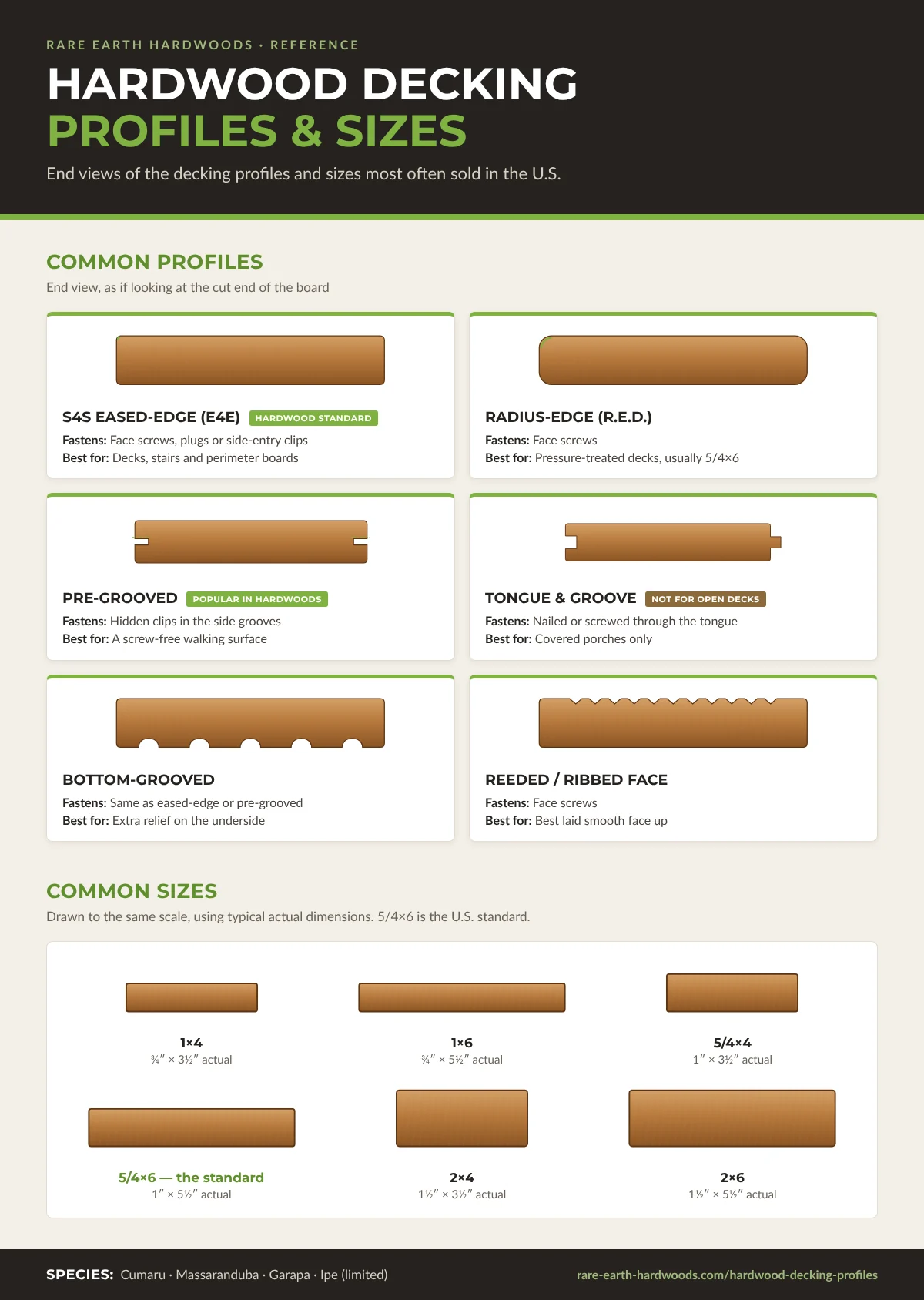
5/4×6 is the standard residential decking board in the United States. If a specification does not name a size, that is usually what is meant. The drawings below are to the same scale, using typical actual (surfaced) dimensions, not the nominal names.

1×4¾″ × 3½″ actual
1×6¾″ × 5½″ actual
5/4×41″ × 3½″ actual
5/4×6 — the standard1″ × 5½″ actual
2×41½″ × 3½″ actual
2×61½″ × 5½″ actual
Nominal sizeTypical actualUsual joist spacingWhere it is used
1×4¾″ × 3½″16″ on centerNarrow modern look; also rails and trim
1×6¾″ × 5½″16″ on centerVery common in hardwoods; a full-width board at a lighter thickness
5/4×41″ × 3½″16–24″ on centerNarrower look with more stiffness; less cupping than a 6″ face
5/4×61″ × 5½″16–24″ on centerThe residential workhorse. Extra thickness allows wider spacing in many hardwoods
2×41½″ × 3½″Up to 24″ on centerWestern cedar and redwood; commercial or heavy-duty hardwood
2×61½″ × 5½″Up to 24″ on centerSame uses as 2×4, at a full 6″ face. Common for Western softwoods
Joist spacing here is typical practice, not a span rating. Confirm spacing with the span data for the species, grade, and how the boards are laid (perpendicular or diagonal). Hardwood decking is often sold in even lengths from 8 to 20 feet.

Common Profiles

These are the edge and face styles you will see on lumberyard racks and in hardwood catalogs. Each drawing is an end view — as if you were looking at the freshly cut end of the board.

S4S eased-edge end view: a 5/4 by 6 board with slightly rounded corners Slight ease on all four corners · smooth face
End view · S4S eased-edge (E4E)
Profile Hardwood standard Face-screwed

S4S Eased-Edge (E4E)

Surfaced on four sides, with a slight radius on all four corners. This is the workhorse hardwood board: a smooth walking face, clean edges that are kinder on bare feet, and a square-enough side for a consistent gap. Boards are typically face-screwed — often with a plug system so the heads disappear — and can also take a side-entry hidden fastener such as CAMO.

Use eased-edge boards at the stairs, benches, and the perimeter of a grooved deck. Clips need a continuous edge to bear against, and a finished outer board looks cleaner without a groove showing on the exposed edge.

  • Most versatile profile: decks, siding, rails, trim, and stair treads
  • Fastest, most economical install; screw heads are visible unless plugged
  • The board you want around the outside of a hidden-fastener deck
Radius-edge decking end view: a 5/4 by 6 board with a quarter-inch radius on the edges Typically a ¼″ radius · almost always 5/4×6
End view · Radius-edge decking (R.E.D.)
Profile Pressure-treated standard Usually 5/4×6

Radius-Edge Decking (R.E.D.)

The dominant profile for pressure-treated Southern Pine, and what eastern U.S. lumberyards stock for treated decking. It is almost always a 5/4×6, with a more generous radius — typically about ¼″ — on the edges. Some mills ease all four edges; others ease only the top two. A related “patio” profile uses an even larger radius.

The rounded edges resist splintering and shed water out of the corner. This is a softwood convention. Brazilian hardwood decking is more often sold as eased-edge (a tighter corner) than as a full radius-edge board, though some imported lines are milled with a visible radius.

  • The board most builders in the eastern U.S. mean when they say “treated decking”
  • Many pros still limit R.E.D. spans to 16″ on center to keep the walking surface firm
  • Do not confuse the larger radius with the slight ease on an S4S hardwood board
Pre-grooved end view: slots in both long edges for hidden fastener clips Side grooves for hidden clips · smooth walking face
End view · Pre-grooved (side-grooved)
Profile Popular in hardwoods Hidden clips

Pre-Grooved (Side-Grooved)

A continuous slot is milled into both long edges so a hidden-fastener clip can sit between the boards. Nothing comes through the walking face: no screw heads to plug, countersink, or corrode. The clips also set a consistent gap and let each board move a little with the weather instead of fighting a fixed screw.

This is very popular for Ipe, Cumaru, Massaranduba, Garapa and other hardwoods, and it is the default on most composite and PVC lines. The groove has to match the clip — height, depth, and system — so order the board and the fastener as a pair. Install solid eased-edge boards at the perimeter and on the stairs.

  • Clean, screw-free walking surface; clips set the gap for you
  • Slightly higher cost, and you need a compatible clip system
  • Not for the outer edge of the deck — finish with eased-edge boards
Tongue and groove end view: interlocking edges with no drainage gap Interlocking edges · covered porches only
End view · Tongue and groove
Profile Covered porches Not for open decks

Tongue and Groove

Boards interlock: a tongue on one edge, a matching groove on the other, with no drainage gap between them. The result is a continuous floor. Because water has nowhere to run, this profile is for covered porches, soffits, ceilings, and lanais only — never for an open or uncovered deck.

Hardwood T&G is commonly sold in 1×4, 1×6, and 5/4×6. On a 1×6, the installed face is a little narrower than the actual 5½″ width (about 5⅛″), because the tongue tucks into the next board. Some yards also offer a V-groove face, which cuts a small shadow line at each joint.

  • A smooth, even porch floor with concealed joints
  • Fasten the first board, then nail or screw through the tongue
  • Use stainless or coated fasteners; this is porch flooring, not decking
Bottom-grooved end view: relief channels on the underside, smooth walking face Relief channels on the underside · face stays smooth
End view · Bottom-grooved
Profile Less common Underside relief

Bottom Grooves

Shallow channels are milled into the underside of an otherwise standard board — eased-edge or pre-grooved on the sides, smooth on top. The grooves give a little extra relief for airflow and can help where ventilation under the deck is tight. They do not change how the board looks from above or how it is fastened on the face.

This is a specialty option some hardwood suppliers offer, sometimes combined with side grooves. It is not a substitute for proper clearance and drainage under the deck. A deck still needs to sit off the ground, with air moving beneath the joists.

  • Walking face stays smooth; the work is on the underside
  • Can be ordered with or without side grooves for hidden clips
  • Ventilation and drainage of the frame still matter more than the grooves
Reeded face end view: parallel grooves on the walking face Ribbed walking face · many installers put this side down
End view · Reeded / ribbed face
Profile Face texture Use with care

Reeded or Ribbed Face

One face is cut with a series of parallel grooves, often with the other face left smooth, so the board is sometimes sold as “reversible.” The ribbed face was long marketed as a traction pattern. In practice, the grooves hold dirt, leaves, and algae, they are hard to sand and refinish, and a fine reed can be slippery when wet because less of the sole touches the wood.

Many professional installers put the reeded side down — if the mill allows it — or skip the pattern and specify a smooth walking face. A grooved underside can help water drip off the joist; a grooved walking face is a different decision, and not the one we recommend as a default.

  • Common on some cedar and imported softwood lines; less so on clear hardwood decking
  • Prefer the smooth face up, unless the product requires the ribbed face on top
  • Do not treat grooves in the walking surface as proof of better grip

Brazilian Hardwood Decking Species

Ipe set the standard for hardwood decking, and it is still the benchmark for hardness and durability. It has also become hard to get in volume, and prices and lead times reflect that. The good news is that every profile on this page can be milled from other dense Brazilian hardwoods, and for most decks there is no reason to wait on Ipe. For a domestic option, see our comparison of black locust vs. Ipe and Brazilian hardwoods.

These are the species we supply consistently for decking:

CumaruJanka hardness about 3,300–3,500 lbf

The closest substitute for Ipe in hardness and weight. Tan to reddish brown, sometimes with a ribbon figure, and it weathers to a soft silver if left unfinished. Sometimes sold as Brazilian Teak.

Best for: projects specified for Ipe, high-traffic decks, docks and boardwalks. Cumaru decking

MassarandubaJanka hardness about 3,200 lbf

Very dense, with a deeper red-brown color than Ipe. A fine, even texture underfoot. Like all dense hardwoods, seal the ends and let it acclimate before installing to limit surface checking.

Best for: clients who want a darker, red-toned deck with Ipe-class density. Massaranduba decking

GarapaAlso called Garapeira · Janka hardness about 1,650–1,700 lbf

A golden, honey-toned hardwood, lighter in weight and easier to cut and fasten than Ipe or Cumaru. Still harder than white oak. The light color suits modern designs and porch floors.

Best for: lighter-colored decks and porches, and projects where weight and workability matter. Garapa (Garapeira)

SpeciesJanka hardnessColorAvailability
IpeAbout 3,500–3,700 lbfOlive to dark brownLimited; ask about current stock
CumaruAbout 3,300–3,500 lbfTan to reddish brownConsistent supply
MassarandubaAbout 3,200 lbfDeep red-brownConsistent supply
GarapaAbout 1,650–1,700 lbfGolden, honey-tonedConsistent supply
White oak (for reference)About 1,360 lbfLight tanDomestic

Janka values vary by source and from board to board; ranges reflect published figures from McIlvain and ToolsToday. Browse the full Brazilian species directory, or see the species pages for Cumaru, Massaranduba and Garapa. All decking: Brazilian hardwood decking.

How the Profiles Work Together

You rarely pick just one. The fastening method, the exposure, and the edge of the deck all play a part.

Open, Exposed Decks

Use eased-edge or pre-grooved boards with a drainage gap between them. Keep a smooth walking face. This is the right place for Cumaru, Massaranduba, Garapa and Ipe in 1× and 5/4 sizes, and for radius-edge treated pine.

Covered Porches

Tongue and groove — including a V-groove face if you want a shadow line — is the porch profile. It is also used for soffits and ceilings. Do not put T&G on an uncovered deck.

Hidden Fasteners

Pre-grooved boards in the field, eased-edge boards at the perimeter, stairs, and any free edge. Match the side groove to the clip system, and follow that system’s instructions.

Brazilian Hardwood Decking

What Moves in Brazilian Hardwood Decking

For Ipe, Cumaru and the other Brazilian hardwoods, distributors typically list 1×4, 1×6, 5/4×4, and 5/4×6, each in eased-edge and pre-grooved, with tongue and groove as a porch option. The two SKUs that move the most are 5/4×6 eased-edge and 5/4×6 pre-grooved. Every one of them can be milled in Cumaru, Massaranduba or Garapa.

A smooth walking face with eased edges is our preferred default for Brazilian hardwood: it is easier to clean and refinish, and the grain is the point of the wood. Side grooves for hidden clips belong on the edges, not on the walking surface.

Frequently Asked Questions

What is the standard decking size in the United States?

5/4×6. Typical actual dimensions are 1″ × 5½″. If a specification does not name a size, that is usually what is meant. Hardwoods are also commonly sold in 1×4, 1×6, and 5/4×4; 2×4 and 2×6 are more typical of Western softwoods and of heavy-duty or commercial work.

Can tongue-and-groove boards go on an open deck?

No. Because the boards interlock with no drainage gap, water has nowhere to run. T&G is for covered porches, soffits, ceilings, and lanais only — never for an open or uncovered deck.

Do I still need eased-edge boards if I use a hidden-clip system?

Yes. Use pre-grooved boards in the field, and solid eased-edge boards at the perimeter, stairs, and any free edge. Clips need a continuous edge to bear against, and a finished outer board looks cleaner without a groove showing on the exposed edge.

Should a reeded or ribbed face go up or down?

Prefer the smooth face up, unless the product requires the ribbed face on top. The grooves hold dirt, leaves, and algae, they are hard to sand and refinish, and a fine reed can be slippery when wet. Many professional installers put the reeded side down if the mill allows it.

Which sizes and profiles move the most in Brazilian hardwood decking?

Distributors typically list 1×4, 1×6, 5/4×4, and 5/4×6, each in eased-edge and pre-grooved, with tongue and groove as a porch option. The two SKUs that move the most are 5/4×6 eased-edge and 5/4×6 pre-grooved.

What can I use instead of Ipe?

Cumaru is the closest match in hardness and weight. Massaranduba is nearly as dense, with a deeper red-brown color. Garapa is lighter in color and weight and easier to work, and still harder than white oak. All three can be milled in the same sizes and profiles as Ipe.

Is Ipe still available?

In limited quantities. Ipe has become hard to source in volume, so we recommend Cumaru, Massaranduba or Garapa for most projects. Ask about current Ipe stock if a project requires it.

Looking for a Profile?

Tell us the size, the species, and how you want it fastened. We mill Brazilian hardwood decking in Cumaru, Massaranduba and Garapa, with Ipe as availability allows, and can help you match the species and board to the job.

Email sales@rehwood.net Or call 231-743-0004 · Traverse City, Michigan · Santarém, Pará, Brazil
Infographic of hardwood decking profiles and sizes: eased-edge, radius-edge, pre-grooved, tongue and groove, bottom-grooved and reeded profiles, and 1×4 through 2×6 board sizes

UNDER NEW OWNERSHIP

We’re in the process of redeveloping our website for our slate of new offerings. 

In the meantime, please send us a message or give us a call.

We’re particularly interested in your wholesale or commercial quantity inquiries. 

Ipe