
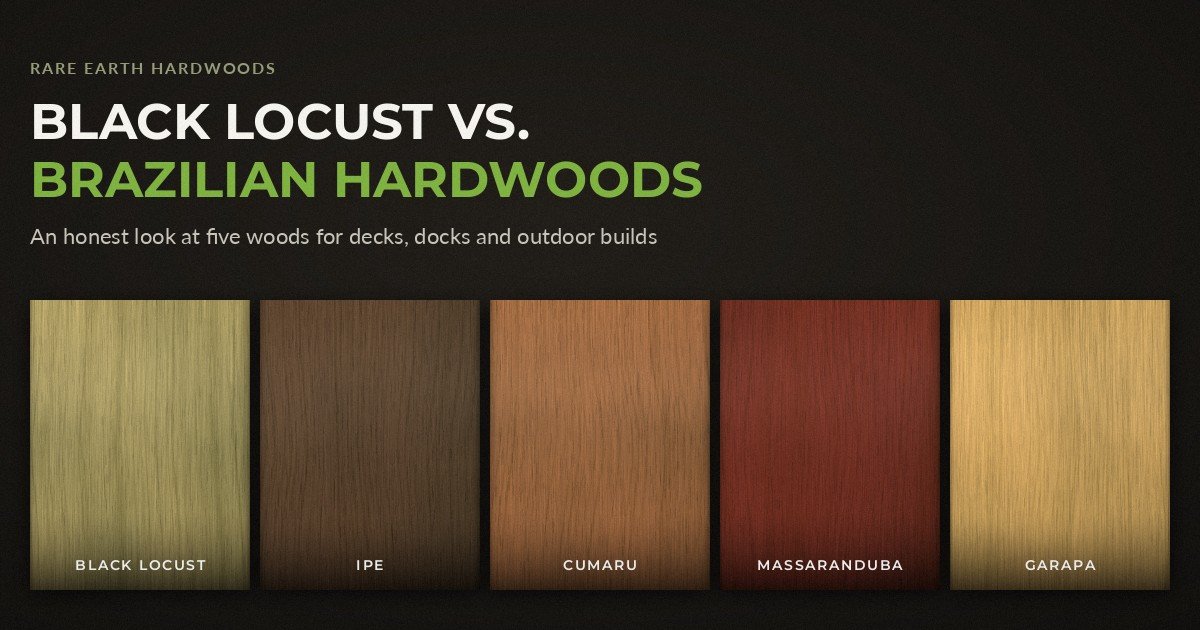
Black locust is a good outdoor wood, and if it fits your project, you should use it. It's tough, rot-resistant, and grown right here in North America.
We sell Brazilian hardwoods, so we're not neutral. But we get asked about locust often enough that we wanted to lay out a fair, side-by-side look at how it stacks up against the tropical species most people are weighing it against: Ipe, Cumaru, Massaranduba and Garapa.
All five hold up outdoors for decades. Here's where they differ.
| Species | Weight (lb/ft³) | Decay Resistance | Typical Lengths | Color |
|---|---|---|---|---|
| Ipe | 69 | Very high | Up to 20' | Dark olive to brown |
| Cumaru | 68 | Very high | Up to 20' | Tan to reddish-brown |
| Massaranduba | 67 | Very high | Up to 20' | Deep red-brown |
| Garapa | 52 | High | Up to 20' | Golden blond |
| Black Locust | 48 | Very high (heartwood only) | Mostly under 12' | Yellow-green, ages to brown |
Figures are approximate and vary board to board. Every one of these woods weathers to silver-gray if left unfinished.
Black locust is about half as hard as Ipe, Cumaru or Massaranduba
Janka hardness in pounds-force (lbf). Higher means more dent-resistant.
Source: The Wood Database, approximate average values.
Garapa sits right alongside black locust. Both are still harder than red oak (about 1,290 lbf).
Hard, dense and naturally rot-resistant, with a long track record in fence posts and boardwalks. The catch is the tree itself: it grows crooked and narrow, so long, clear, wide boards are scarce. Only the heartwood is durable, so grading matters.
Best for: projects where domestic sourcing is a priority and shorter board lengths work.
The benchmark everyone compares to. Extremely hard, very stable, very long-lasting. It's also heavy, tough on tools, and currently harder to source in volume.
Best for: high-traffic commercial decks and boardwalks.
Nearly as hard and dense as Ipe, with a warmer, reddish tone. It moves a little more with moisture, so proper acclimation and spacing matter.
Best for: anyone who wants Ipe-level performance with a warmer color.
Hard, heavy and a rich deep red. It can surface-check if it dries too fast, so it rewards end-sealing and good install practice.
Best for: decks, docks and siding where a deep red color is the goal.
About as hard as black locust but lighter in weight and color. Easier to cut and handle than the denser species, and it comes in long lengths.
Best for: a light, bright look, and crews who want a more workable hardwood.
Performance is only half the decision. The other half is whether you can actually get the wood, in the sizes you need, when you need it.
| Species | Availability | Long Lengths | Trade Paperwork |
|---|---|---|---|
| Black Locust | Limited, few specialty mills | Rare | Domestic, none |
| Ipe | Tight right now | Yes | CITES Appendix II permits |
| Cumaru | Good | Yes | CITES Appendix II permits |
| Massaranduba | Good | Yes | Standard import (Lacey Act) |
| Garapa | Good | Yes | Standard import (Lacey Act) |
Ipe and Cumaru were added to CITES Appendix II in late 2024. That doesn't make them illegal. It means every shipment needs export permits. Whatever species you choose, ask your supplier to show you the documentation.
Black locust usually sits at the top of this group on price, roughly even with Ipe per linear foot. Cumaru, Massaranduba and Garapa generally come in noticeably below both.
The reason is mostly the tree, not the market. Black locust grows crooked and fairly narrow, so a mill gets far fewer long, clear, wide boards out of each log. The rest becomes shorter stock, posts or firewood. That low yield gets built into the price of every decking board.
The Brazilian species grow tall and straight, with wide trunks. A single log yields much more usable decking, which keeps the cost per foot down. Prices move with the market, so ask for a current quote on Brazilian hardwood decking in your sizes and lengths.
| If You Want… | Consider |
|---|---|
| Domestic wood, short runs | Black Locust |
| Maximum hardness and long lengths | Cumaru or Massaranduba |
| A warm reddish-brown deck | Cumaru |
| A deep red color | Massaranduba |
| A light, golden look that's easier to work | Garapa |
| Lighter weight for siding or rooftop decks | Garapa or Black Locust |
For rot resistance, they're close. Both last decades outdoors untreated. Ipe is about twice as hard, so it resists dents and wear better. With locust, only the heartwood is durable, so grading matters.
Yes. Left unfinished, all five species weather to silver-gray. A penetrating oil slows the change if you want to keep the original color.
Yield. The trees grow crooked and narrow, so each log produces only a few long, clear decking boards.
Cumaru. It's nearly as hard and dense, with a warmer reddish-brown tone.
Yes. Both have been listed under CITES Appendix II since late 2024. That means every shipment needs export permits, not that the wood is banned.
Garapa. It's lighter and cuts more easily than the dense species. As with any hardwood decking, pre-drill your fasteners.
There's no wrong answer here. Every wood on this list will outlast pressure-treated pine by many years. If you'd like samples, or want to talk through what makes sense for your project, get in touch. We'll give you a straight answer, even if it's that black locust is the better fit.
Inquire About Your Project →We’re in the process of redeveloping our website for our slate of new offerings.
In the meantime, please send us a message or give us a call.
We’re particularly interested in your wholesale or commercial quantity inquiries.